Case Study
Nova Island
NOVA Island is a game-based learning concept for children ages 8–12 that combines math, reading, and creative exploration within a shared interactive world.

Snapshot
Role
Product Designer and UX Researcher
Duration
2 weeks
Type
Independent, research-informed concept.


Overview
What if learning felt like the best part of the game?
NOVA Island is a game-based learning concept for children ages 8–12 that combines math, reading, and creative exploration within a shared interactive world.
Instead of interrupting gameplay with unrelated exercises, learning becomes the action that moves the adventure forward. Children repair bridges using fractions, follow story clues to rescue characters, and develop their island through what they discover.
The project explores how educational products can support academic understanding, emotional confidence, and meaningful play without relying on pressure-based engagement.

Problem
Academic difficulty is only part of the challenge.
Ontario’s assessment results revealed a significant difference between achievement in mathematics and literacy, alongside lower reported confidence and enjoyment in math.
In the 2024–2025 assessment results:
51% of Grade 6 students met the provincial mathematics standard.
86% met the provincial reading standard.
48% of Grade 6 students reported enjoying mathematics.
35,396 students in a matched cohort did not meet the mathematics standard across either assessed grade.
These numbers do not prove that a learning game will improve achievement. They do, however, highlight an important design opportunity: children may need support not only with academic content, but also with confidence, motivation, and recovering when they become stuck.
Design Challenge
How might we create a learning experience that helps children understand challenging concepts while making the process feel meaningful, approachable, and genuinely enjoyable?


Research Approach
I connected public education data, learning science, and product analysis before defining the solution.
Because NOVA Island is an independent concept, the research process focused on verifiable secondary evidence rather than invented interviews or unsupported usability claims.
My research included:
Ontario mathematics and literacy assessment results.
Published studies on math anxiety, motivation, and child development.
Research examining the integration of learning into game mechanics.
Analysis of existing educational products, including Prodigy Math and Prodigy English.
Accessibility, instructional design, and child-safety considerations.
I organized the project into four stages:
Discover: Understand the education landscape, learner attitudes, existing products, and relevant academic research.
Define: Identify the most important opportunities around motivation, cognitive load, and independent problem-solving.
Develop: Explore game mechanics, map task flows, compare interaction models, and create high-fidelity iPad and mobile experiences.
Validate: Define the research activities and success measures needed to test the concept with children, caregivers, and educators.

Comperative Analysis
Existing educational games already make learning engaging. The opportunity is how deeply learning is integrated into play.
Prodigy Math demonstrates how curriculum-aligned questions can support quests, progression, and character-driven adventure. Prodigy English introduces a village-building environment where learning contributes to gameplay and resource collection.
Rather than positioning NOVA Island as the first educational game or the first cozy learning world, I focused on a more specific interaction opportunity:
Can the academic action directly change the object or situation the child is engaging with?
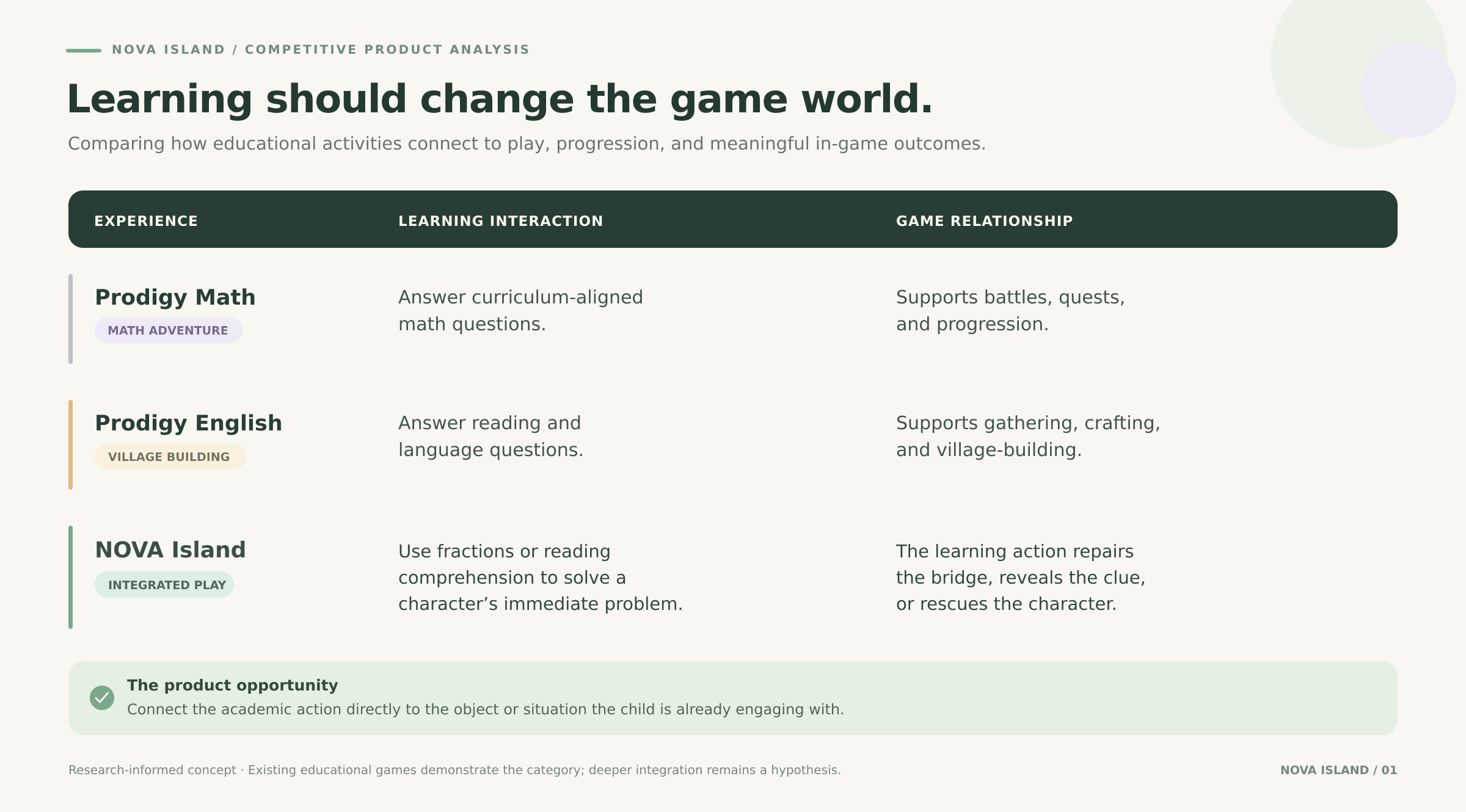
The distinction is not simply visual style. It is whether the learning task functions as a meaningful game mechanic instead of a separate requirement surrounding the game.
The distinction is not simply visual style. It is whether the learning task functions as a meaningful game mechanic instead of a separate requirement surrounding the game.

Research Synthesis
Four recurring themes shaped the product direction.
After reviewing assessment data, academic studies, accessibility guidance, and existing learning products, I organized the evidence into four actionable themes.
1. Confidence affects participation.
A difficult question becomes harder to engage with when the experience introduces unnecessary pressure, punishment, or uncertainty.
2. Learning needs a meaningful purpose.
Children should understand why a task matters within the game, rather than completing disconnected exercises to return to the activity they enjoy.
3. Recovery is part of the experience.
The first incorrect answer should create an opportunity for guidance, not a dead end.
4. Caregivers need understandable progress.
Families need to know what a child practiced and how they can help without being expected to interpret complicated performance dashboards.
These themes became design hypotheses rather than claims about observed user behavior.

Learning Psycology
Psychological research influenced specific interface and gameplay decisions.
I did not want learning psychology to appear as a collection of theories disconnected from the product. Each framework needed to change something visible in the experience.
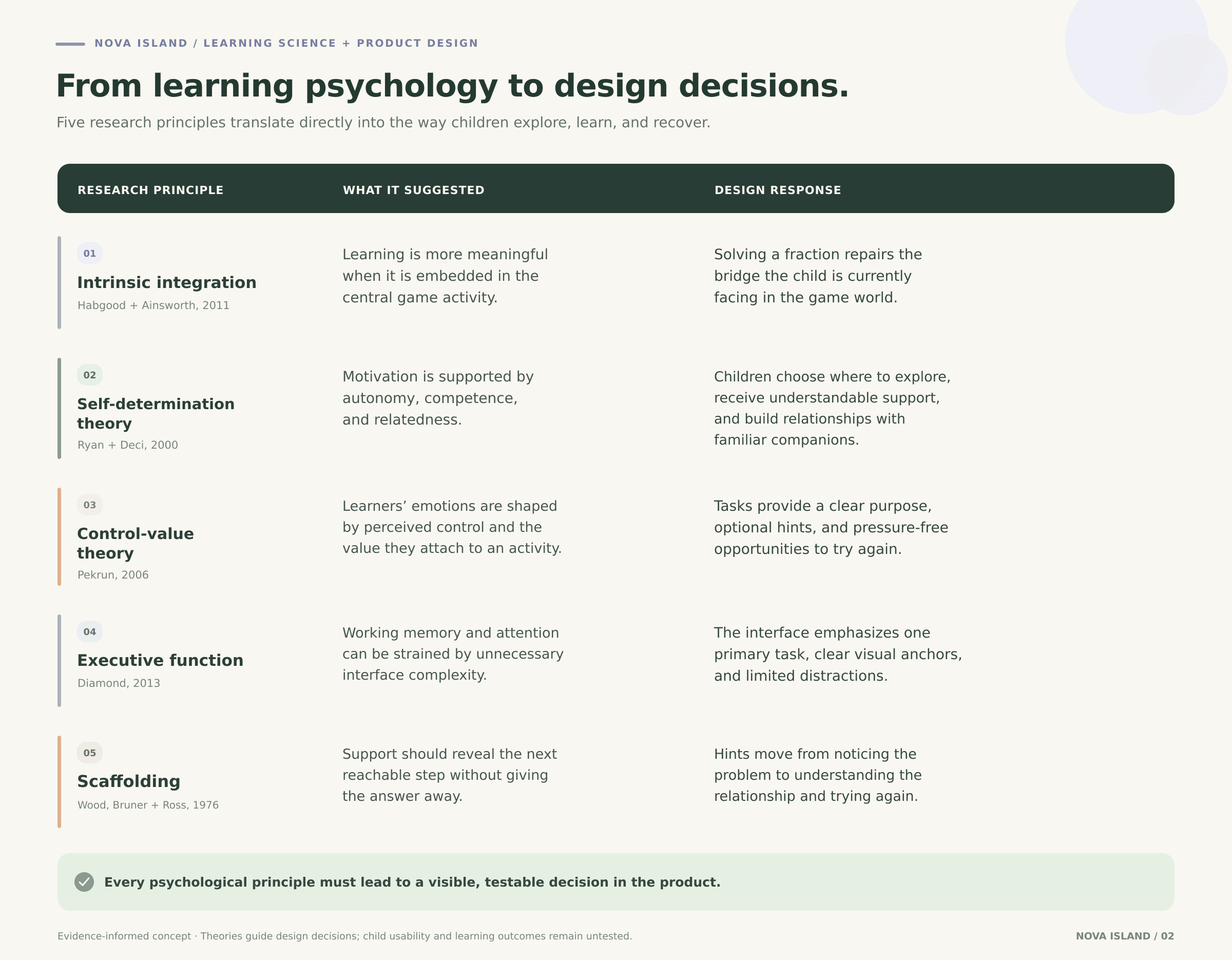
This led to one central product principle:
The learning action should feel like the game action.


Understanding the learner journey
The most important moment is what happens after the first wrong answer.
I mapped the learning journey around a child exploring the island, encountering a character who needs help, attempting a task, and responding to uncertainty.
The highest-risk moment occurs when the child does not immediately know the answer.
A conventional interaction may encourage repeated guessing, remove progress, or present an unclear failure message. NOVA Island instead keeps the child within the game environment and offers support that makes the next action easier to understand.

Proposed journey:
Discover a character who needs help.
Understand the problem in the environment.
Attempt a relevant math or reading task.
Access an optional clue when needed.
Retry without losing progress.
Watch the environment change.
Choose whether to continue or finish.
The learner and caregiver represented in the case study are evidence-informed proto-personas, not participants from completed interviews.

Product strategy and interaction design
I designed the experience around recovery, clarity, and meaningful consequences.
The central game loop connects four actions:
Encounter → Understand → Change the world → Grow.
A character presents a problem. The child applies a relevant academic skill. The environment visibly changes. That completed action contributes to longer-term progress across the island.
The most important branch occurs when an answer is incorrect. Instead of ending the interaction, the experience offers a clue, preserves the game context, and gives the child another opportunity to solve the problem.

For the core math encounter:
A character needs to cross a damaged bridge.
The bridge is missing one of four equal sections.
The child identifies the missing fraction.
An optional clue highlights the relevant relationship.
Choosing the correct piece repairs the bridge.
The character crosses safely and the island changes.
This structure keeps the academic objective, character motivation, and game consequence connected.
Wireframes and iteration
The final concept emerged from comparing three different interaction models. I explored multiple directions before committing to the final game structure.

Version 1: Subject-first dashboard
Children selected a math or reading activity from a conventional learning interface.
Why I moved away from it: The experience felt like homework organized inside a friendly-looking app.
Version 2: Game world with separate quiz prompts
Children explored an island but had to leave the experience or open a separate question to continue.
Why I moved away from it: The academic task still interrupted the game rather than becoming part of it.
Version 3: Integrated game encounter
Children solve problems directly within the world, using academic understanding to change what happens next.
Why I selected it: The task, character motivation, and environmental outcome remain connected throughout the interaction.
Low-fidelity wireframes helped clarify the structure before visual details and character artwork were introduced.


Final experience: math as an interactive game
Fractions become the action that repairs the world.
In NOVA Island, a fraction is not presented as an unrelated question that unlocks a reward later. It becomes the action needed to solve a visible problem.
When a character cannot cross a damaged bridge, the child identifies the missing fraction and completes the structure. The interaction connects the mathematical concept to an immediate, understandable outcome.

The experience supports:
Visual representation of equal parts.
Direct interaction with fraction pieces.
Optional hints without punishment.
Immediate feedback tied to the game environment.
A clear connection between the learning action and the result.
The iPad interface provides additional space for manipulatives, larger controls, and a persistent visual connection to the game world. The mobile experience presents the same journey through a sequence of focused screens.

Final experience: reading as exploration
Reading comprehension helps children find clues and rescue characters.
The same game world also supports literacy activities without turning reading into a disconnected multiple-choice exercise.
Children follow an interactive story, identify relevant details, and apply what they understood to help a character navigate the environment.

The reading experience includes:
Story-based exploration.
Contextual comprehension questions.
Visual connections between the narrative and the island.
Optional read-aloud support.
Adjustable text and reduced distraction.
Clear outcomes tied to helping another character.
One important instructional consideration is that audio support changes what the interaction can claim to measure. A read-aloud experience can support listening comprehension and participation, but it should not automatically be reported as independent decoding.


Accessibility and caregiver experience

Inclusive play should be part of the product, not an afterthought.
Children do not all approach reading, movement, sound, or visual complexity in the same way. NOVA Island includes flexible settings designed to make the experience easier to access without isolating children from the main game.
The concept includes:
Read-aloud support.
Adjustable text presentation.
Reduced motion.
Softer sound settings.
Clear, accessible touch interactions.
The ability to progress without timers or punishment.
Optional clues that preserve independence.
Caregiver summaries focused on the skill practiced and one suggested next step.
The caregiver experience translates gameplay into practical educational context without overwhelming families with excessive analytics.

Validation and success measures
Success would be measured through understanding and recovery, not time spent playing.
(Because NOVA Island is a concept, primary research and product outcomes have not yet been validated)
The proposed next phase would include moderated research with:
Approximately 12 children ages 8–12.
Approximately 8 caregivers.
Approximately 6 educators.
Research would focus on whether children:
Understand why a character needs help.
Recognize the relationship between the task and the game world.
Locate and use a clue without adult assistance.
Retry after an incorrect response.
Explain why the selected answer works.
Apply the same concept in another context.
Feel comfortable stopping after completing a quest.
Caregiver and educator research would evaluate instructional clarity, curriculum alignment, accessibility, and the usefulness of progress summaries

Proposed success categories:
Understanding: Can the child explain the concept and identify what changed?
Independent recovery: Can the child find support and continue without relying on an adult?
Responsible engagement: Does the experience remain enjoyable without pressure, compulsive play, or punishment?
Accessibility and trust: Can children use supported interaction paths, and can caregivers understand what was learned?
Evaluate instructional clarity, curriculum alignment, accessibility, and the usefulness of progress summaries

Reflection
The strongest learning experience is not a game with educational content added on.
NOVA Island explores what happens when learning, interaction design, motivation, and play are treated as parts of the same product system.
The project challenged me to move beyond familiar education-app patterns and consider how academic understanding can create a visible, meaningful change within a game world.
Its strongest idea is also its simplest: when a child solves a problem, they should understand not only that they succeeded, but also why it mattered.
Project outputs:
22 mobile screens.
15 iPad screens.
An interactive game prototype.
Research synthesis and learning-science analysis.
Task flows, low-fidelity wireframes, and documented iterations.
A proposed child-safe research and validation framework.
The best learning mechanic should feel like the best part of the game.
Case Study
Nova Island
NOVA Island is a game-based learning concept for children ages 8–12 that combines math, reading, and creative exploration within a shared interactive world.
Snapshot
Role
Product Designer and UX Researcher
Duration
2 weeks
Type
Independent, research-informed concept.
Overview
What if learning felt like the best part of the game?
NOVA Island is a game-based learning concept for children ages 8–12 that combines math, reading, and creative exploration within a shared interactive world.
Instead of interrupting gameplay with unrelated exercises, learning becomes the action that moves the adventure forward. Children repair bridges using fractions, follow story clues to rescue characters, and develop their island through what they discover.
The project explores how educational products can support academic understanding, emotional confidence, and meaningful play without relying on pressure-based engagement.
Problem
Academic difficulty is only part of the challenge.
Ontario’s assessment results revealed a significant difference between achievement in mathematics and literacy, alongside lower reported confidence and enjoyment in math.
In the 2024–2025 assessment results:
51% of Grade 6 students met the provincial mathematics standard.
86% met the provincial reading standard.
48% of Grade 6 students reported enjoying mathematics.
35,396 students in a matched cohort did not meet the mathematics standard across either assessed grade.
These numbers do not prove that a learning game will improve achievement. They do, however, highlight an important design opportunity: children may need support not only with academic content, but also with confidence, motivation, and recovering when they become stuck.
Design Challenge
How might we create a learning experience that helps children understand challenging concepts while making the process feel meaningful, approachable, and genuinely enjoyable?
Research Approach
I connected public education data, learning science, and product analysis before defining the solution.
Because NOVA Island is an independent concept, the research process focused on verifiable secondary evidence rather than invented interviews or unsupported usability claims.
My research included:
Ontario mathematics and literacy assessment results.
Published studies on math anxiety, motivation, and child development.
Research examining the integration of learning into game mechanics.
Analysis of existing educational products, including Prodigy Math and Prodigy English.
Accessibility, instructional design, and child-safety considerations.
I organized the project into four stages:
Discover: Understand the education landscape, learner attitudes, existing products, and relevant academic research.
Define: Identify the most important opportunities around motivation, cognitive load, and independent problem-solving.
Develop: Explore game mechanics, map task flows, compare interaction models, and create high-fidelity iPad and mobile experiences.
Validate: Define the research activities and success measures needed to test the concept with children, caregivers, and educators.
Comperative Analysis
Existing educational games already make learning engaging. The opportunity is how deeply learning is integrated into play.
Prodigy Math demonstrates how curriculum-aligned questions can support quests, progression, and character-driven adventure. Prodigy English introduces a village-building environment where learning contributes to gameplay and resource collection.
Rather than positioning NOVA Island as the first educational game or the first cozy learning world, I focused on a more specific interaction opportunity:
Can the academic action directly change the object or situation the child is engaging with?
The distinction is not simply visual style. It is whether the learning task functions as a meaningful game mechanic instead of a separate requirement surrounding the game.
The distinction is not simply visual style. It is whether the learning task functions as a meaningful game mechanic instead of a separate requirement surrounding the game.
Research Synthesis
Four recurring themes shaped the product direction.
After reviewing assessment data, academic studies, accessibility guidance, and existing learning products, I organized the evidence into four actionable themes.
1. Confidence affects participation.
A difficult question becomes harder to engage with when the experience introduces unnecessary pressure, punishment, or uncertainty.
2. Learning needs a meaningful purpose.
Children should understand why a task matters within the game, rather than completing disconnected exercises to return to the activity they enjoy.
3. Recovery is part of the experience.
The first incorrect answer should create an opportunity for guidance, not a dead end.
4. Caregivers need understandable progress.
Families need to know what a child practiced and how they can help without being expected to interpret complicated performance dashboards.
These themes became design hypotheses rather than claims about observed user behavior.
Learning Psycology
Psychological research influenced specific interface and gameplay decisions.
I did not want learning psychology to appear as a collection of theories disconnected from the product. Each framework needed to change something visible in the experience.
This led to one central product principle:
The learning action should feel like the game action.
Understanding the learner journey
The most important moment is what happens after the first wrong answer.
I mapped the learning journey around a child exploring the island, encountering a character who needs help, attempting a task, and responding to uncertainty.
The highest-risk moment occurs when the child does not immediately know the answer.
A conventional interaction may encourage repeated guessing, remove progress, or present an unclear failure message. NOVA Island instead keeps the child within the game environment and offers support that makes the next action easier to understand.
Proposed journey:
Discover a character who needs help.
Understand the problem in the environment.
Attempt a relevant math or reading task.
Access an optional clue when needed.
Retry without losing progress.
Watch the environment change.
Choose whether to continue or finish.
The learner and caregiver represented in the case study are evidence-informed proto-personas, not participants from completed interviews.
Product strategy and interaction design
I designed the experience around recovery, clarity, and meaningful consequences.
The central game loop connects four actions:
Encounter → Understand → Change the world → Grow.
A character presents a problem. The child applies a relevant academic skill. The environment visibly changes. That completed action contributes to longer-term progress across the island.
The most important branch occurs when an answer is incorrect. Instead of ending the interaction, the experience offers a clue, preserves the game context, and gives the child another opportunity to solve the problem.
For the core math encounter:
A character needs to cross a damaged bridge.
The bridge is missing one of four equal sections.
The child identifies the missing fraction.
An optional clue highlights the relevant relationship.
Choosing the correct piece repairs the bridge.
The character crosses safely and the island changes.
This structure keeps the academic objective, character motivation, and game consequence connected.
Wireframes and iteration
The final concept emerged from comparing three different interaction models. I explored multiple directions before committing to the final game structure.
Version 1: Subject-first dashboard
Children selected a math or reading activity from a conventional learning interface.
Why I moved away from it: The experience felt like homework organized inside a friendly-looking app.
Version 2: Game world with separate quiz prompts
Children explored an island but had to leave the experience or open a separate question to continue.
Why I moved away from it: The academic task still interrupted the game rather than becoming part of it.
Version 3: Integrated game encounter
Children solve problems directly within the world, using academic understanding to change what happens next.
Why I selected it: The task, character motivation, and environmental outcome remain connected throughout the interaction.
Low-fidelity wireframes helped clarify the structure before visual details and character artwork were introduced.
Final experience: math as an interactive game
Fractions become the action that repairs the world.
In NOVA Island, a fraction is not presented as an unrelated question that unlocks a reward later. It becomes the action needed to solve a visible problem.
When a character cannot cross a damaged bridge, the child identifies the missing fraction and completes the structure. The interaction connects the mathematical concept to an immediate, understandable outcome.
The experience supports:
Visual representation of equal parts.
Direct interaction with fraction pieces.
Optional hints without punishment.
Immediate feedback tied to the game environment.
A clear connection between the learning action and the result.
The iPad interface provides additional space for manipulatives, larger controls, and a persistent visual connection to the game world. The mobile experience presents the same journey through a sequence of focused screens.
Final experience: reading as exploration
Reading comprehension helps children find clues and rescue characters.
The same game world also supports literacy activities without turning reading into a disconnected multiple-choice exercise.
Children follow an interactive story, identify relevant details, and apply what they understood to help a character navigate the environment.
The reading experience includes:
Story-based exploration.
Contextual comprehension questions.
Visual connections between the narrative and the island.
Optional read-aloud support.
Adjustable text and reduced distraction.
Clear outcomes tied to helping another character.
One important instructional consideration is that audio support changes what the interaction can claim to measure. A read-aloud experience can support listening comprehension and participation, but it should not automatically be reported as independent decoding.
Accessibility and caregiver experience
Inclusive play should be part of the product, not an afterthought.
Children do not all approach reading, movement, sound, or visual complexity in the same way. NOVA Island includes flexible settings designed to make the experience easier to access without isolating children from the main game.
The concept includes:
Read-aloud support.
Adjustable text presentation.
Reduced motion.
Softer sound settings.
Clear, accessible touch interactions.
The ability to progress without timers or punishment.
Optional clues that preserve independence.
Caregiver summaries focused on the skill practiced and one suggested next step.
The caregiver experience translates gameplay into practical educational context without overwhelming families with excessive analytics.
Validation and success measures
Success would be measured through understanding and recovery, not time spent playing.
(Because NOVA Island is a concept, primary research and product outcomes have not yet been validated)
The proposed next phase would include moderated research with:
Approximately 12 children ages 8–12.
Approximately 8 caregivers.
Approximately 6 educators.
Research would focus on whether children:
Understand why a character needs help.
Recognize the relationship between the task and the game world.
Locate and use a clue without adult assistance.
Retry after an incorrect response.
Explain why the selected answer works.
Apply the same concept in another context.
Feel comfortable stopping after completing a quest.
Caregiver and educator research would evaluate instructional clarity, curriculum alignment, accessibility, and the usefulness of progress summaries
Proposed success categories:
Understanding: Can the child explain the concept and identify what changed?
Independent recovery: Can the child find support and continue without relying on an adult?
Responsible engagement: Does the experience remain enjoyable without pressure, compulsive play, or punishment?
Accessibility and trust: Can children use supported interaction paths, and can caregivers understand what was learned?
Evaluate instructional clarity, curriculum alignment, accessibility, and the usefulness of progress summaries
Reflection
The strongest learning experience is not a game with educational content added on.
NOVA Island explores what happens when learning, interaction design, motivation, and play are treated as parts of the same product system.
The project challenged me to move beyond familiar education-app patterns and consider how academic understanding can create a visible, meaningful change within a game world.
Its strongest idea is also its simplest: when a child solves a problem, they should understand not only that they succeeded, but also why it mattered.
Project outputs:
22 mobile screens.
15 iPad screens.
An interactive game prototype.
Research synthesis and learning-science analysis.
Task flows, low-fidelity wireframes, and documented iterations.
A proposed child-safe research and validation framework.
The best learning mechanic should feel like the best part of the game.
Case Study
Nova Island
NOVA Island is a game-based learning concept for children ages 8–12 that combines math, reading, and creative exploration within a shared interactive world.
Snapshot
Role
Product Designer and UX Researcher
Duration
2 weeks
Type
Independent, research-informed concept.
Overview
What if learning felt like the best part of the game?
NOVA Island is a game-based learning concept for children ages 8–12 that combines math, reading, and creative exploration within a shared interactive world.
Instead of interrupting gameplay with unrelated exercises, learning becomes the action that moves the adventure forward. Children repair bridges using fractions, follow story clues to rescue characters, and develop their island through what they discover.
The project explores how educational products can support academic understanding, emotional confidence, and meaningful play without relying on pressure-based engagement.
Problem
Academic difficulty is only part of the challenge.
Ontario’s assessment results revealed a significant difference between achievement in mathematics and literacy, alongside lower reported confidence and enjoyment in math.
In the 2024–2025 assessment results:
51% of Grade 6 students met the provincial mathematics standard.
86% met the provincial reading standard.
48% of Grade 6 students reported enjoying mathematics.
35,396 students in a matched cohort did not meet the mathematics standard across either assessed grade.
These numbers do not prove that a learning game will improve achievement. They do, however, highlight an important design opportunity: children may need support not only with academic content, but also with confidence, motivation, and recovering when they become stuck.
Design Challenge
How might we create a learning experience that helps children understand challenging concepts while making the process feel meaningful, approachable, and genuinely enjoyable?
Research Approach
I connected public education data, learning science, and product analysis before defining the solution.
Because NOVA Island is an independent concept, the research process focused on verifiable secondary evidence rather than invented interviews or unsupported usability claims.
My research included:
Ontario mathematics and literacy assessment results.
Published studies on math anxiety, motivation, and child development.
Research examining the integration of learning into game mechanics.
Analysis of existing educational products, including Prodigy Math and Prodigy English.
Accessibility, instructional design, and child-safety considerations.
I organized the project into four stages:
Discover: Understand the education landscape, learner attitudes, existing products, and relevant academic research.
Define: Identify the most important opportunities around motivation, cognitive load, and independent problem-solving.
Develop: Explore game mechanics, map task flows, compare interaction models, and create high-fidelity iPad and mobile experiences.
Validate: Define the research activities and success measures needed to test the concept with children, caregivers, and educators.
Comperative Analysis
Existing educational games already make learning engaging. The opportunity is how deeply learning is integrated into play.
Prodigy Math demonstrates how curriculum-aligned questions can support quests, progression, and character-driven adventure. Prodigy English introduces a village-building environment where learning contributes to gameplay and resource collection.
Rather than positioning NOVA Island as the first educational game or the first cozy learning world, I focused on a more specific interaction opportunity:
Can the academic action directly change the object or situation the child is engaging with?
The distinction is not simply visual style. It is whether the learning task functions as a meaningful game mechanic instead of a separate requirement surrounding the game.
The distinction is not simply visual style. It is whether the learning task functions as a meaningful game mechanic instead of a separate requirement surrounding the game.
Research Synthesis
Four recurring themes shaped the product direction.
After reviewing assessment data, academic studies, accessibility guidance, and existing learning products, I organized the evidence into four actionable themes.
1. Confidence affects participation.
A difficult question becomes harder to engage with when the experience introduces unnecessary pressure, punishment, or uncertainty.
2. Learning needs a meaningful purpose.
Children should understand why a task matters within the game, rather than completing disconnected exercises to return to the activity they enjoy.
3. Recovery is part of the experience.
The first incorrect answer should create an opportunity for guidance, not a dead end.
4. Caregivers need understandable progress.
Families need to know what a child practiced and how they can help without being expected to interpret complicated performance dashboards.
These themes became design hypotheses rather than claims about observed user behavior.
Learning Psycology
Psychological research influenced specific interface and gameplay decisions.
I did not want learning psychology to appear as a collection of theories disconnected from the product. Each framework needed to change something visible in the experience.
This led to one central product principle:
The learning action should feel like the game action.
Understanding the learner journey
The most important moment is what happens after the first wrong answer.
I mapped the learning journey around a child exploring the island, encountering a character who needs help, attempting a task, and responding to uncertainty.
The highest-risk moment occurs when the child does not immediately know the answer.
A conventional interaction may encourage repeated guessing, remove progress, or present an unclear failure message. NOVA Island instead keeps the child within the game environment and offers support that makes the next action easier to understand.
Proposed journey:
Discover a character who needs help.
Understand the problem in the environment.
Attempt a relevant math or reading task.
Access an optional clue when needed.
Retry without losing progress.
Watch the environment change.
Choose whether to continue or finish.
The learner and caregiver represented in the case study are evidence-informed proto-personas, not participants from completed interviews.
Product strategy and interaction design
I designed the experience around recovery, clarity, and meaningful consequences.
The central game loop connects four actions:
Encounter → Understand → Change the world → Grow.
A character presents a problem. The child applies a relevant academic skill. The environment visibly changes. That completed action contributes to longer-term progress across the island.
The most important branch occurs when an answer is incorrect. Instead of ending the interaction, the experience offers a clue, preserves the game context, and gives the child another opportunity to solve the problem.
For the core math encounter:
A character needs to cross a damaged bridge.
The bridge is missing one of four equal sections.
The child identifies the missing fraction.
An optional clue highlights the relevant relationship.
Choosing the correct piece repairs the bridge.
The character crosses safely and the island changes.
This structure keeps the academic objective, character motivation, and game consequence connected.
Wireframes and iteration
The final concept emerged from comparing three different interaction models. I explored multiple directions before committing to the final game structure.
Version 1: Subject-first dashboard
Children selected a math or reading activity from a conventional learning interface.
Why I moved away from it: The experience felt like homework organized inside a friendly-looking app.
Version 2: Game world with separate quiz prompts
Children explored an island but had to leave the experience or open a separate question to continue.
Why I moved away from it: The academic task still interrupted the game rather than becoming part of it.
Version 3: Integrated game encounter
Children solve problems directly within the world, using academic understanding to change what happens next.
Why I selected it: The task, character motivation, and environmental outcome remain connected throughout the interaction.
Low-fidelity wireframes helped clarify the structure before visual details and character artwork were introduced.
Final experience: math as an interactive game
Fractions become the action that repairs the world.
In NOVA Island, a fraction is not presented as an unrelated question that unlocks a reward later. It becomes the action needed to solve a visible problem.
When a character cannot cross a damaged bridge, the child identifies the missing fraction and completes the structure. The interaction connects the mathematical concept to an immediate, understandable outcome.
The experience supports:
Visual representation of equal parts.
Direct interaction with fraction pieces.
Optional hints without punishment.
Immediate feedback tied to the game environment.
A clear connection between the learning action and the result.
The iPad interface provides additional space for manipulatives, larger controls, and a persistent visual connection to the game world. The mobile experience presents the same journey through a sequence of focused screens.
Final experience: reading as exploration
Reading comprehension helps children find clues and rescue characters.
The same game world also supports literacy activities without turning reading into a disconnected multiple-choice exercise.
Children follow an interactive story, identify relevant details, and apply what they understood to help a character navigate the environment.
The reading experience includes:
Story-based exploration.
Contextual comprehension questions.
Visual connections between the narrative and the island.
Optional read-aloud support.
Adjustable text and reduced distraction.
Clear outcomes tied to helping another character.
One important instructional consideration is that audio support changes what the interaction can claim to measure. A read-aloud experience can support listening comprehension and participation, but it should not automatically be reported as independent decoding.
Accessibility and caregiver experience
Inclusive play should be part of the product, not an afterthought.
Children do not all approach reading, movement, sound, or visual complexity in the same way. NOVA Island includes flexible settings designed to make the experience easier to access without isolating children from the main game.
The concept includes:
Read-aloud support.
Adjustable text presentation.
Reduced motion.
Softer sound settings.
Clear, accessible touch interactions.
The ability to progress without timers or punishment.
Optional clues that preserve independence.
Caregiver summaries focused on the skill practiced and one suggested next step.
The caregiver experience translates gameplay into practical educational context without overwhelming families with excessive analytics.
Validation and success measures
Success would be measured through understanding and recovery, not time spent playing.
(Because NOVA Island is a concept, primary research and product outcomes have not yet been validated)
The proposed next phase would include moderated research with:
Approximately 12 children ages 8–12.
Approximately 8 caregivers.
Approximately 6 educators.
Research would focus on whether children:
Understand why a character needs help.
Recognize the relationship between the task and the game world.
Locate and use a clue without adult assistance.
Retry after an incorrect response.
Explain why the selected answer works.
Apply the same concept in another context.
Feel comfortable stopping after completing a quest.
Caregiver and educator research would evaluate instructional clarity, curriculum alignment, accessibility, and the usefulness of progress summaries
Proposed success categories:
Understanding: Can the child explain the concept and identify what changed?
Independent recovery: Can the child find support and continue without relying on an adult?
Responsible engagement: Does the experience remain enjoyable without pressure, compulsive play, or punishment?
Accessibility and trust: Can children use supported interaction paths, and can caregivers understand what was learned?
Evaluate instructional clarity, curriculum alignment, accessibility, and the usefulness of progress summaries
Reflection
The strongest learning experience is not a game with educational content added on.
NOVA Island explores what happens when learning, interaction design, motivation, and play are treated as parts of the same product system.
The project challenged me to move beyond familiar education-app patterns and consider how academic understanding can create a visible, meaningful change within a game world.
Its strongest idea is also its simplest: when a child solves a problem, they should understand not only that they succeeded, but also why it mattered.
Project outputs:
22 mobile screens.
15 iPad screens.
An interactive game prototype.
Research synthesis and learning-science analysis.
Task flows, low-fidelity wireframes, and documented iterations.
A proposed child-safe research and validation framework.
The best learning mechanic should feel like the best part of the game.